Hi there,
Here's my weekly update for Oct 12, 2026...
🎥 Alan Gervais tells us about his practical guide to manage OSHA inspections

Someday, someone may walk into your workplace and say three words you’ll never forget:
“OSHA is here.
”
What happens next?
Who talks to the inspector?
🎥 Mastering AI Prompts: Using the SMART Acronym for Safety and Accuracy

The speaker explains how to treat AI as a team member or mentee, emphasizing that while the machine generates content, the professional's role shifts to being a fact-checker and copy editor to ensure safety and ethical standards.
By applying the SMART acronym—Specific, Measurable, Attainable, Realistic, and Timely—to prompts, users can significantly improve the quality and relevance of the AI's output.
Viewers will learn how to divert their brain space toward quality control and fairness, ensuring that final products remain accurate and representative of their professional standards.
🎥 Conversation about AI for IH with Hillary Waterhouse, MPH, CIH

Let's meet Hillary Waterhouse:
Hillary Waterhouse, MPH, CIH, Principal and Owner of Waterhouse Technical Reports & Case Documentation, LLC, has earned a regional and national reputation for her detailed exposure assessments.
Her credentials include board certification in industrial hygiene (CIH) and Master’s Degree in Public Health from the University of Minnesota.
She has an expansive technical understanding of Occupational Safety and Health Administration (OSHA) regulations, Environmental Protection Agency (EPA) chemical management programs under the Toxic Substances Control Act (TSCA), and complex industrial hygiene assessment methodologies.
🎥 Automating Safety Compliance: Auditing OSHA Policies with AI Assistants

The speaker explains how to leverage AI assistants like Gemini to maintain regulatory compliance by feeding the system OSHA "absolutes" and comparing them against existing company programs.
By using the Hazard Communication (Hascom) standard as a primary example, the guide demonstrates a process for auditing safety manuals to satisfy ISO 45001 requirements and annual OSHA review recommendations.
Viewers will learn how to transition from manual updates to a proactive "Plan-Do-Check-Act" system, including an introduction to AI agents that autonomously monitor regulatory changes to ensure policies never fall out of date.
🗒️ PAPod 619 - Normalization of Excellence: Turning Safety into Strength
In this episode, Todd explores the evolution of safety thinking—from blaming human error to creating systems that support reliable work.
He discusses the normalization of deviance versus a deliberate shift toward a normalization of excellence, learning teams, and practical examples of redesigning work to prevent repeats of incidents.
Through conversations about AI-created interviews, Southwest Airlines' practices, and Case studies, Todd emphasizes treating error as normal, asking better questions, and designing systems that make work safer and more effective.
Click here to listen to the podcast
🗒️ How to Use AI for Safety Programs and EHS Training-Part 2
Are you ready to revolutionize your safety consulting business with the power of artificial intelligence?
In this episode, Sheldon Primus breaks down how AI is transforming the EHS field and why you need to treat it as a high level mentee rather than a replacement for your expertise.
Learn how to stay ahead of the curve by integrating these cutting edge tools into your daily workflow while maintaining the highest ethical standards.Sheldon explores the practical side of AI for Environmental Health and Safety professionals.
He discusses the importance of fairness, transparency, and accountability when using generative models.
You will discover how to use AI for copywriting safety messages, creating sample programs, and even conducting deep dives into incident investigations.
Click here to listen to the podcast
🗒️ Safety Wars 10-7-2026 Cornell--Accountability is Necesary, Prevention Takes More
Safety Wars: Cornell — Accountability Is Necessary, Prevention Takes MoreIn this 33-minute Safety Wars episode, host Jim examines the Cornell sexual assault case — dubbed the "Cornell Seven" — through a safety-investigation and human-organizational-performance (HOP) lens.
Drawing on a Slate article by consultant Hannah Scotland, Pulsel argues that punishment alone won't prevent the next catastrophe: individuals may change, but conditions persist.
He unpacks consent law, the role of intoxication, and perverse incentives that silence both victims and perpetrators.
The episode draws direct parallels to workplace safety culture — where people walk by hazards, avoid rocking the boat, and face institutional pressure to look the other way.
Pulsel calls for meaningful prevention: practical intervention skills, clear reporting routes, and environments where people can speak without retaliation.
Click here to listen to the podcast
🗒️ Changing Leadership: How True Leaders Transform and Grow
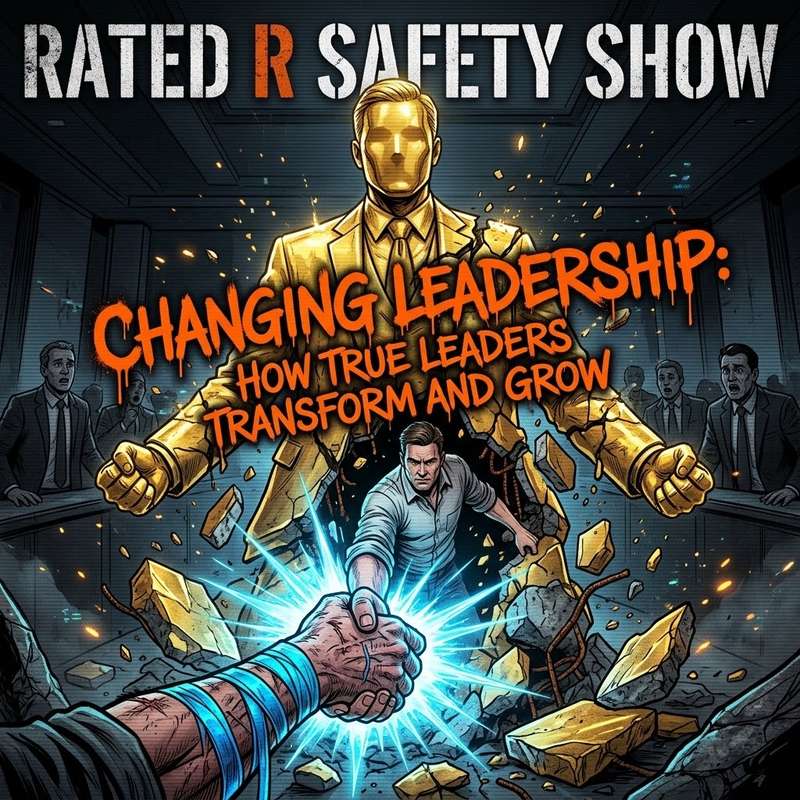
The override breakers are fried and the transdimensional static is screaming for this October 6, 2026 broadcast, patching the chaos out of the Safety FM studios in Orlando.
Today’s spectrum is jagged: we hijack the feed from global oil price chess matches, torch the canned compliance clowns and punch through the static of safety theater.
The multiverse grid is crackling with everything from trade cold wars to viral outbreaks, but we’re yanking the Map right out of the Black Iron Prison’s hands.
This episode is pure anti-bureaucratic voltage—smashing through leadership facades, calling out institutional cowardice and spotlighting what really happens when systems get sabotaged from the inside.Track Breakdown & Segment NotesThe Bureaucratic Intrusion: This episode rips the lid off how bureaucratic inertia calcifies both safety and progress.
The show slices through staged safety theater and exposes how “the system” always shifts blame while pretending to reinvent itself.
Click here to listen to the podcast
Enjoy, Sheldon Primus
0 comments